Contact us
 Visit CPRE.org
 Donate
Happy days with Hedgerow Heroes

Andrea Griffiths, CPRE Kent director, celebrates our branch taking on a project that puts the accent wholly on the positive
I have always had an unquenchable passion for trees – and smaller trees in hedgerows are no exception. I think hedgerows are the unsung heroes of the countryside, playing so many vital roles.
From butterflies to bats and dormice to dunnocks, hedgerows provide homes and food for wildlife and offer vital green corridors that help animals to move between sites. This helps reduce habitat fragmentation, reconnecting our countryside and landscape.
Hedgerows support a vast number of creatures, including many farmland birds and rarer protected species. They sequester carbon and so help to fight climate change. They reduce flooding and purify water, improving its quality. Being made up of a dense collection of trees, they improve air quality. They are vital for reducing soil loss and maintaining and improving soil health, and they act as a natural green barrier, keeping livestock in and helping to improve biosecurity.
As well as the ecosystem services they provide, there are also strong historical and cultural links to hedgerows, too. Did you know that springtime hawthorn blossom, collected often from local hedgerows, was the original wedding confetti and the traditional blossom to decorate maypoles?
Hedgerows have always played a key part in giving our countryside its unique character.
With the services they provide, their blossom and berries, what’s not to like about these seasonally-changing natural powerhouses?
Well, given how hedgerows have been treated in England in the last few decades, you’d be forgiven for dismissing their importance. They have been massively overlooked and taken for granted. Hedgerows, to be fair, need to be maintained by human intervention to reach their full potential, so people perhaps have overlooked the myriad of vital services they provide.
We know from aerial photographs that hedgerow cover did not change much between the late 1800s and the 1940s. However, between the 1950s and 1975, mainly due to agricultural practices changing, the loss of hedgerows across England was nothing short of shocking. The decline has continued. Hedgerow surveying indicated that there was more than 500,000 kilometres of managed hedgerow in England in 1984, but by 2007 (a mere 23 years later) more than 100,000km had been lost!
People are now more aware of the importance of hedgerows, but it was only in 1997 that the first legal protection for them was introduced. After a long campaign by CPRE, the Hedgerow Regulations were created, which finally gave some hedgerows the designation of ‘important’. Unfortunately, we still find that many hedgerows are cast aside (like many other natural features) if the perceived overriding public good of a development demands the space. Fences are arguably easier to maintain, too, and one of the biggest threats now comes from new roads, especially along the edges of existing and new settlements.
Sadly, many of the hedges that remain have been managed poorly, or not at all. An overgrown hedge does not provide as secure a habit for wildlife as a managed one. A hedge trimmed too frequently might die prematurely. Both these scenarios can cause gappy hedges that no longer keep back livestock or provide a continuous corridor for wildlife. In addition, if historically unmanaged, much more management, and therefore time, is needed to restore them to their full glory. In this scenario, sadly some people decided it was easier to remove them.
To address the hedgerow horror of the last 50-plus years, in 2020 CPRE launched the Hedgerow Heroes project with an overall aim to plant and/or rejuvenate 100 miles of hedgerow across England before the end of this, our centenary year. In this time, via externally sourced and distributed funds, the national team have been supporting county CPRE branches with planting and restoration projects. CPRE Kent took part for the first time in Phase 5: 2025-26.
Lorraine Ray, Hedgerow Heroes project management officer for the national CPRE team, brings together all the branches involved. She said: “With 13 counties now taking part, it’s no small task… but it’s an exciting one. Collecting statistics and data is a crucial part of the project, helping us demonstrate real impact on the ground.
“We work hard behind the scenes to secure funding and make sure the project runs well. The enthusiasm and positive feedback from volunteers, partners and landowners highlight just how much this project means to people. We’re so glad that CPRE Kent have joined us this season and the work they’ve done is fantastic.”
In 2025-26, across England the 13 involved counties collectively planned to plant and/or rejuvenate 26 miles of hedgerow. Of this, CPRE Kent had 2.5 miles (3,998m). That might not sound like much for the whole county, but that distance equates to almost 20,000 trees – and that was just for Kent alone this year.
CPRE Kent put a shout-out for sites in spring last year and we were inundated with potential hedgerow locations. Our funding bid was submitted and we were delighted to be awarded the funds to proceed and have concluded by working across 22 sites this year.
Working in partnership with Countryside Management Partnership teams, sites were visited and assessed, landowner agreements signed, dates set, risk assessments written, trees and materials ordered and volunteers recruited.
We did lose some potential meterage due to issues on site (deer pressure and safety issues, for example), which sadly took our target down from an original 7,667m to 3,998m, but, aside from this, the project has gone swimmingly, with fantastic partnerships and community and volunteer involvement. Indeed, in the end, we managed to go slightly over the new target and achieved a final total of 4,140m.
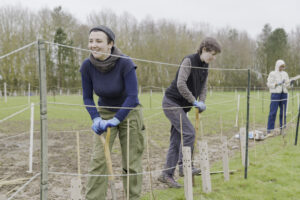
Hedgerows are not just brilliant for our wildlife and countryside; they are good for people, too. There is so much evidence on how spending time outdoors in nature is good for our mental as well as physical well-being and the feedback from the volunteers who have been involved with Hedgerow Heroes this winter has reflected this. Meeting other people, being outdoors, helping to create spaces for wildlife, doing something meaningful and learning a traditional craft were all among the answers given when people were asked why they had enjoyed taking part.
From our youngest volunteer (Kimberley, aged six) to one of our oldest (Adrian, 82), we have had hundreds of people volunteering in Kent alone. It’s been a wonderful turn-out of people from all walks of life and ages.
Included were members of Scout and youth groups, corporate teams, members of staff from councils and long-standing conservation volunteers working with the Countryside Management Partnership teams. Some were planting trees for the first time, while some had been doing it for years. All were welcome and all enjoyed the experience, saying they would recommend it to others.
CPRE staff also got involved, both members of the national team and from Kent.
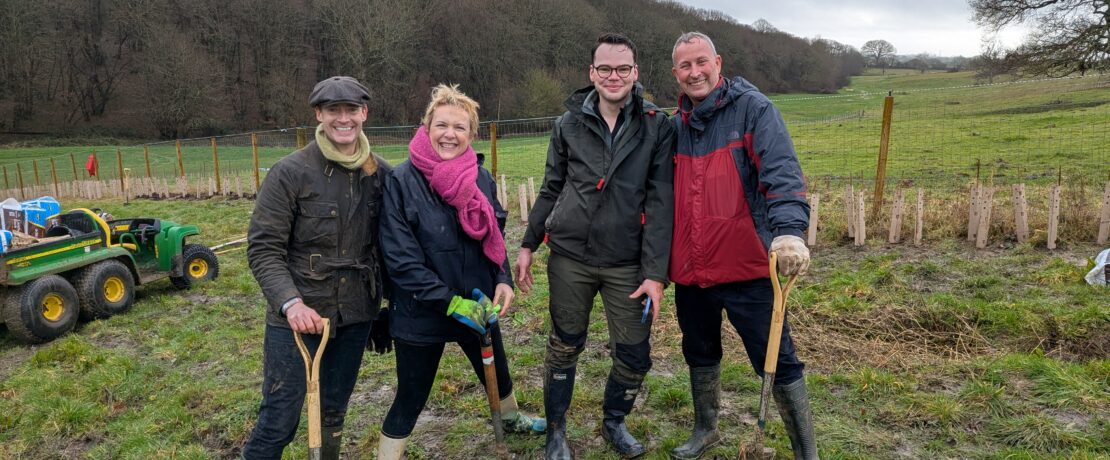
Martin Collett, a national CPRE trustee, joined one of the task days with his colleagues from English Rural. “Days like this remind me why the work of organisations like English Rural and CPRE matters. There’s huge power in local action, strong communities and a shared belief in a sustainable future,” he said after a very wet and muddy February task day.
And after helping plant some 200 metres of hedgerow near Faversham with the Medway Swale Estuary Partnership, CPRE Kent’s own David Mairs said: “We’re a positive bunch at CPRE Kent, but it might not always seem that way as we so often find ourselves in an adversarial system fighting for the countryside.
“So it’s heartening just now and again to get out and do something unequivocally beneficial for the county’s landscape, nature and people – and joining our Hedgerow Heroes in the lovely village of Eastling for a morning’s planting just before Christmas gave me a real lift away from what can sometimes feel like a constant struggle. Become a Hedgerow Hero – it makes you feel good.”
We have also worked with other volunteer groups such as Trees for Farms, Grow 19 and Youngwilders, the latter a youth-led conservation organisation empowering younger people to undertake practical conservation activities. Alongside Kentish Stour Countryside Partnership and CPRE Kent staff, volunteers with Youngwilders helped complete the planting of a hedge at a site north-east of Canterbury on what is now known as Hedgentines Day, February (Hedgeuary) 21st.
They say the pen is mightier than the sword and we at CPRE Kent spend much of our time fighting with planning, policy… and pens. As such, it made a nice change to temporarily have spades in hand and dirt around our fingers. For me, coming from a countryside management and ecological background, rather than one of policy or planning, it has been a more familiar place and it was nice to be out and about again (despite the rain and wind).
The project has allowed CPRE Kent to engage with new partners and audiences and via highlighting our work to more people we have gained many new supporters. We have also, of course, planted and/or rejuvenated, more than 2.5 miles of hedgerow across the county, increasing habitat for wildlife and reducing fragmentation while also helping people get outside, learn new skills, make new friends and connect with nature.
We dearly hope to repeat the project at new sites and with new contacts in the winter of 2026-27. Until then, many thanks to the Hedgerow Hero volunteers, to our partners at the Countryside Management Partnership teams, to CPRE national and of course the Hedgerow Hero funders.