Contact us
 Visit CPRE.org
 Donate
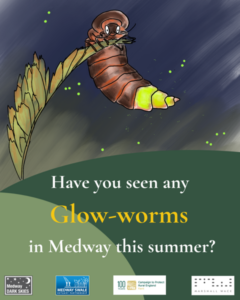
Have you seen glow-worms in Medway? Survey is after your records
They’re a kind of magic… you’re taking an evening stroll in the woods or over the downs and then, seemingly from nowhere, you see them, the specks of dazzling green on the ground or the low vegetation ahead of you. It’s a special moment that too few people experience… we speak, of course, of encounters with glow-worms.
And now there’s the opportunity for people in and around Medway to make such wonderful moments count and help ensure the presence of glow-worms in the area for many years to come.
We at CPRE Kent are among a range of conservation groups who want your records of glow-worms in Medway so we can determine how well these fascinating creatures are faring across the district.
These are not easy times for glow-worms, which are not worms but beetles, and they are in decline across much of the country. The usual suspects are in there as reasons for that decline – habitat loss, climate change, use of pesticides, changing farming methods, urban development and the obsession with ‘tidying up’ our green spaces are all among the factors in the dock – but glow-worms also face another menace: light pollution.
This is yet another reason our Medway Dark Skies campaign is so important – by encouraging dark skies through reducing and limiting light pollution, we can hopefully help stem the decline of such wildlife as glow-worms.
You can spot them from mid-May to mid-September, but the prime period to come across that wondrous glow comprises the months of June, July and August. The range of habitats is varied – they can be found in hedgerows, railway embankments and even gardens, along with the more expected areas out in the countryside.
It is hoped that, by establishing where glow-worms have been seen in Medway, we can expand the survey’s focus next year.
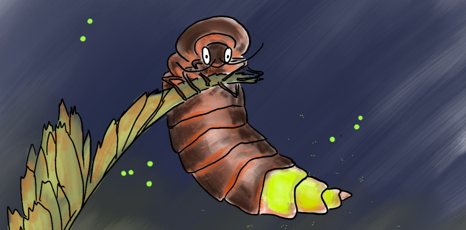
Although larvae and very occasionally adult males can glow, primarily it is the non-flying adult females that shine bright as they bid to attract mates (the flying males). After the female has mated, her light darkens, she lays her eggs and she dies… she will have lived no more than three weeks as an adult.
Although there is almost a romantic pathos to that tale, it is of course the cycle of life. What would be very far from romantic would be the death of the entire species in Medway… please help us ensure that doesn’t happen.
- If you see a glow-worm in the Medway district, please send your record to info@cprekent.org.uk or info@msep.org.uk